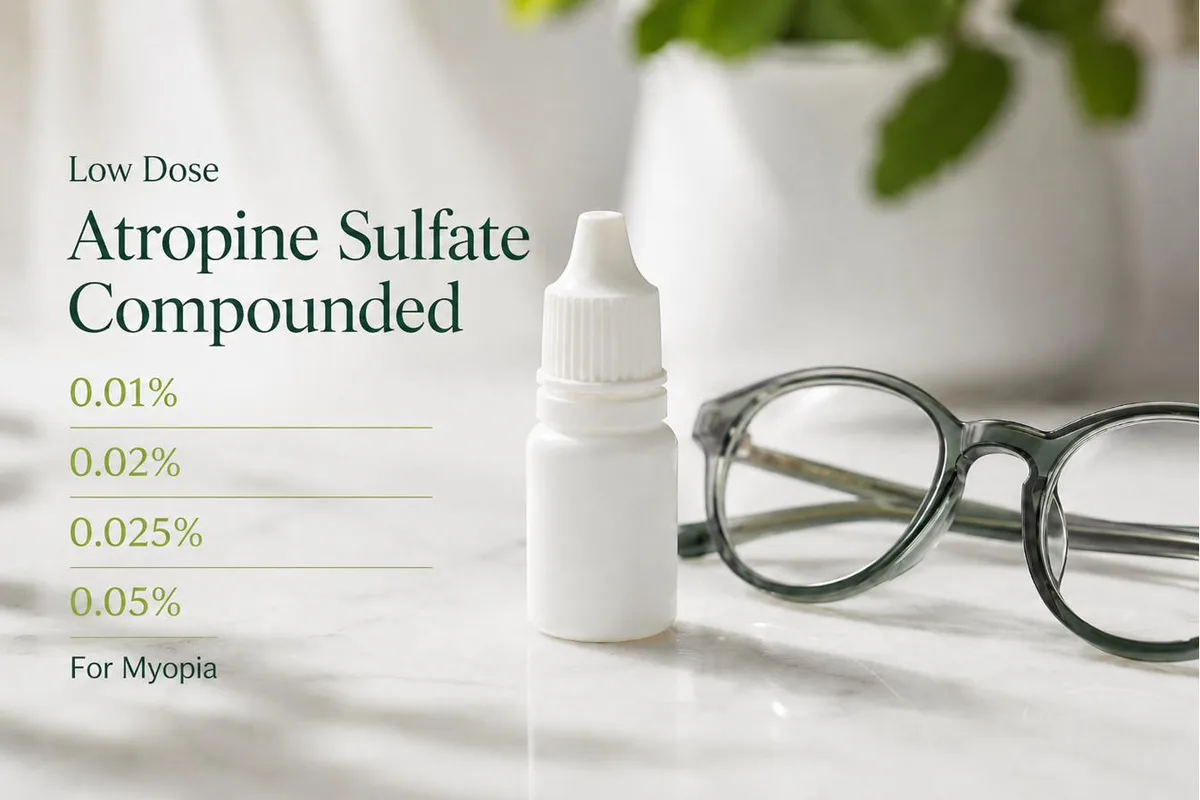
Childhood nearsightedness tends to march: a little worse each year, each visit. Low-dose atropine, prescribed by an optometrist or ophthalmologist at 0.01 to 0.05 percent, is one of the evidence-supported tools for slowing that march. These concentrations are not commercially manufactured in Canada, so they are compounded; Mediglen prepares them to your prescriber's exact strength.
Myopia that progresses through childhood does more than thicken glasses. Higher final prescriptions carry higher lifetime risks to eye health, which is why eye care has shifted from simply correcting myopia to actively managing its progression.
Low-dose atropine is one of the management tools with multi-year trial evidence behind it, including the LAMP study, which compared 0.01, 0.025, and 0.05 percent drops against placebo in children and found slower progression with treatment. The prescriber weighs that evidence for your child and chooses the starting concentration; many begin low and step up only if progression continues.
One drop in each eye at bedtime is the typical regimen. Treatment runs over years, alongside regular follow-up measurements.
Low-dose atropine is a dilute eye drop, typically 0.01 to 0.05 percent, prescribed to slow the progression of nearsightedness in children. At these concentrations it works at a fraction of the strength used for eye examinations, which is why it must be compounded.
Clinical trials, including the multi-year LAMP study, found that nightly low-dose atropine slowed myopia progression in children compared with placebo, with higher concentrations in the low-dose range generally showing larger effects. Your optometrist or ophthalmologist will discuss what the evidence means for your child.
Optometrists and ophthalmologists. They select the concentration, monitor progression at follow-up visits, and adjust the prescription. Mediglen compounds the drops to that prescription; we do not select the strength.
We compound atropine sulfate 0.01, 0.02, 0.025, and 0.05 percent ophthalmic drops, and other concentrations on prescriber request.
At low concentrations side effects are uncommon and usually mild: temporary light sensitivity or near-focus blur in some children, more noticeable at higher concentrations. Report anything persistent to the prescriber; concentration can often be adjusted.
Each bottle is labelled with its storage conditions and a beyond-use date set under compounding standards, which is shorter than a manufactured product's expiry. We schedule refills so a fresh bottle is ready before the current one ages out.