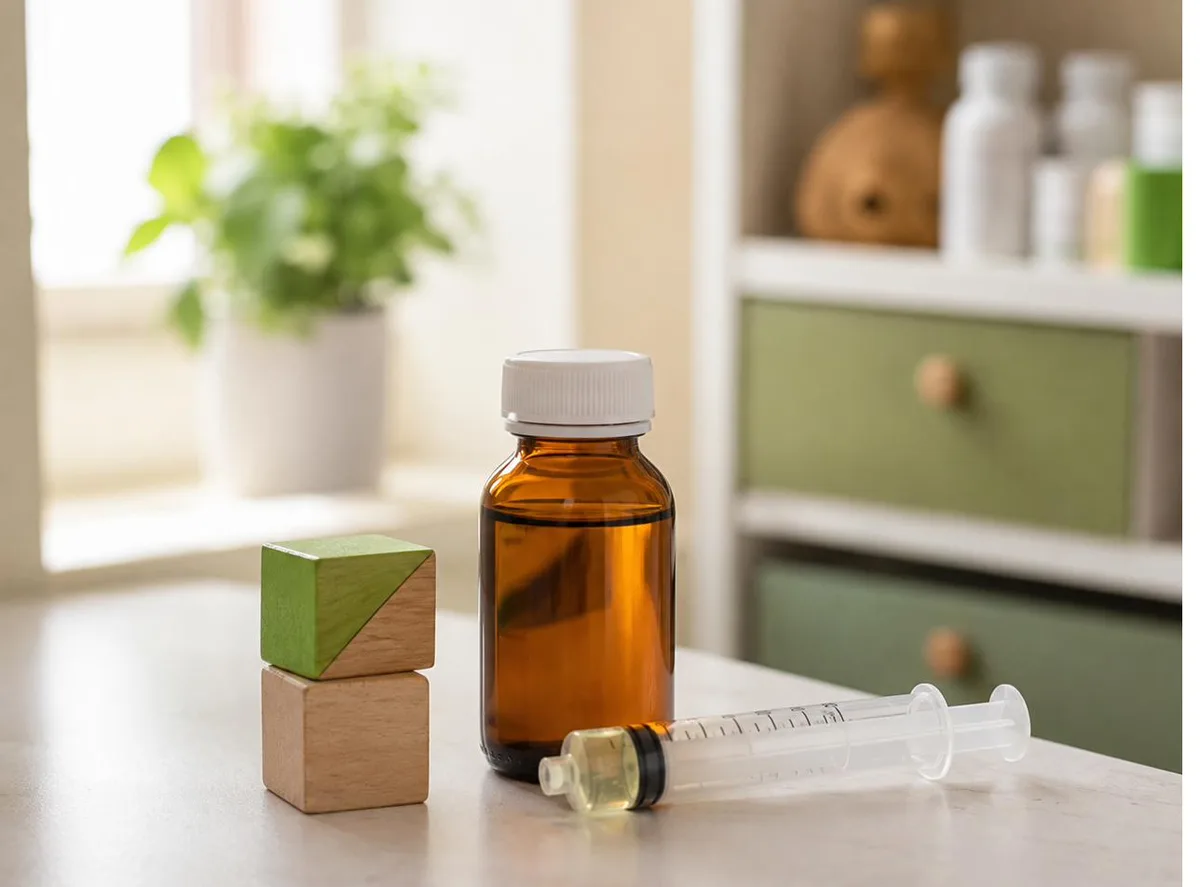
Most medications are manufactured for adults who can swallow tablets. Children are dosed by weight, often need fractions no tablet provides, and frequently cannot or will not swallow pills. Mediglen reformulates prescription medications into flavoured liquid suspensions and other child-appropriate forms, dosed to the milligram your prescriber orders.
A cardiologist orders 3.2 mg of a drug sold only as 10 mg tablets. A toddler needs a quarter of a capsule that cannot be split. A child gags on anything solid, or reacts to the red dye in the only liquid version sold. These are ordinary weeks in paediatric care, and they all end the same way: a prescription that cannot be filled as written from manufactured stock.
Reformulation solves it at the source. The active ingredient is prepared as a suspension at a concentration that makes the ordered dose a clean, measurable volume on an oral syringe. The dose changes as the child grows; the suspension concentration simply follows.
A sample from the reformulation list we work from, all prepared to prescription where stability data supports a suspension:
If a medication is not on the list, we check published stability data before saying yes or no.
Taking a medication that exists only as a tablet or capsule and preparing it as something a specific patient can actually take: most often a flavoured liquid suspension with an oral syringe for exact dosing.
A wide range, where stability data supports it: examples from our formulary include levothyroxine, omeprazole and lansoprazole, propranolol, clonidine, gabapentin, baclofen, spironolactone, sertraline, and many others. If your child's medication is not listed anywhere, ask; we check the compounding literature.
Yes, and that is much of the point. Paediatric dosing is calculated per kilogram, and a liquid lets the prescriber order the precise milligram amount rather than the nearest fraction of a tablet.
Flavouring is part of the formulation, chosen with the family. For children with strong sensory preferences we keep what works on file, and our autism compounding page covers that work in depth.
Yes. Suspensions are built from the active ingredient and a known base, so dyes, common allergens, and unnecessary excipients can be left out by design.
Each suspension carries a beyond-use date based on published stability data, often 14 to 90 days depending on the drug, with storage instructions on the label. Refills are scheduled so you are never caught with an expired bottle.